

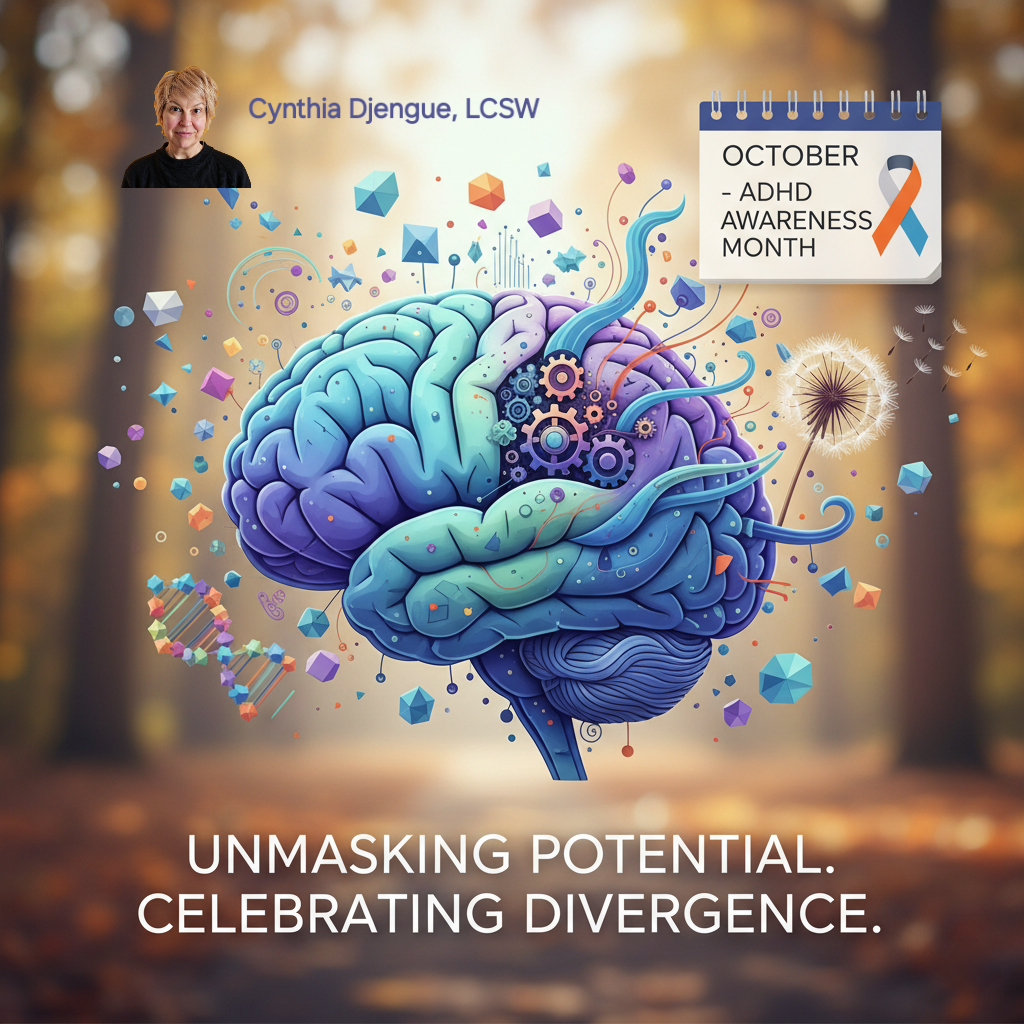
October is ADHD awareness month
Why ADHD Awareness is Essential for Real-Life Treatment
Cynthia Djengue, LCSW, LISW
October is ADHD Awareness Month, a critical time to move past misunderstandings and focus on the serious realities of Attention-Deficit/Hyperactivity Disorder. As a therapist and couples counselor who works with clients managing ADHD, anxiety, PTSD, and childhood trauma, I know firsthand that accurate awareness is the foundation for appropriate treatment. ADHD isn't a personality quirk; it's a neurodevelopmental condition that significantly impacts daily functioning, relationships, and mental health.
Understanding ADHD is Crucial for Treatment
ADHD is a complex neurodevelopmental disorder that impacts executive functions - the mental skills that help us plan, organize, manage time, and control impulses.
When a client understands their diagnosis - that their struggles are rooted in a difference in brain function, not a moral failing or laziness - it shifts the focus from "What's wrong with me?" to "How does my brain work, and how can I best support it?"
Accurate Diagnosis: Awareness helps individuals, parents, and partners recognize that symptoms like chronic disorganization, emotional volatility, or constant procrastination aren't simply "character flaws." This recognition is the first step toward seeking a formal evaluation and evidence-based treatment.
Targeted Interventions: Effective treatment for ADHD is multimodal, meaning it combines different approaches. The American Psychiatric Association (APA) and the National Institute of Mental Health (NIMH) support:
Behavioral Therapy: Including parent training, individual therapy (especially Cognitive Behavioral Therapy (CBT), which is often used to address co-occurring anxiety and mood issues), and psychoeducation.
Medication: For many, stimulant and non-stimulant medications are highly effective in managing core symptoms.
Coaching and Certified ADHD specialists: Some practitioners are also certified in either coaching or ADHD training and can provide real-world support for executive function deficits like planning and organization.
Addressing Comorbidities: ADHD is rarely alone. As you know, comorbidities - co-occurring conditions - are the norm, not the exception. The high rates of conditions like Anxiety Disorders, Major Depressive Disorder, Learning Disorders, and Substance Use Disorders are frequently discussed in current research (e.g., Faraone et al., 2021). This was also mentioned in a recent podcast with Dr. Bessel Van der Kolk . Treating the ADHD can significantly improve these related issues, but only if the primary condition is properly identified. This is why a therapist with expertise in conditions like childhood trauma and PTSD is essential, as these often complicate or mimic ADHD symptoms.
A Call for True Understanding: Reclaiming the Narrative of ADHD
October is ADHD Awareness Month, and while it's a time for celebration and advocacy, it must be approached with honesty. My goal as a therapist and couples counselor, helping individuals and couples navigate anxiety, childhood trauma, and PTSD, is to promote a clear, evidence-based understanding of Attention-Deficit Hyperactivity Disorder.
This month, let's commit to moving past clichés like “ADHD is a superpower” and embracing an understanding of ADHD that is both compassionate and grounded in science.
Why True ADHD Awareness is Crucial for Appropriate Treatment
ADHD is a complex neurodevelopmental disorder - a difference in the brain's executive function system - not a simple matter of willpower or focus. For those with ADHD, the brain’s unique wiring can cause significant impairments in daily life, often leading to a cascade of secondary mental health issues.
The National Institute of Mental Health (NIMH) and the American Psychiatric Association (APA) consistently stress that effective treatment must be multimodal and tailored to the individual's specific presentation. Awareness helps clients, families, and clinicians recognize that:
Symptoms are Persistent and Pervasive: ADHD symptoms must be persistent, present in multiple settings (home, school, work), and clearly interfere with functioning or development, as outlined in the DSM-5.
Accurate Diagnosis Leads to Targeted Care: Without proper awareness, ADHD symptoms are often mislabeled as anxiety, poor motivation, defiance, or depression. An accurate diagnosis shifts the focus from "What's wrong with me?" to "How does my brain work, and how can I best support it?" This allows for the integration of therapies like Cognitive Behavioral Therapy (CBT), mindfulness, and, often, medication - all of which are evidence-based treatments that have been shown to significantly improve outcomes.
The Adult Experience is Different: In adulthood, hyperactivity often manifests as a feeling of internal restlessness or a "motor running," and inattention leads to chronic disorganization, time blindness, and emotional dysregulation. Recognizing these adult-specific signs is key to providing appropriate support.
The Experience for Women may be Different: ADHD often presents differently in women due to a tendency toward internalized symptoms, such as inattentiveness, emotional dysregulation, and anxiety, which can be less disruptive and therefore underrecognized compared to hyperactivity seen more commonly in males. Hormonal fluctuations and social expectations around behavior and caregiving roles may further obscure diagnosis and contribute to delayed or missed identification in females.
Recognizing the Symptoms of ADHD
ADHD symptoms fall into two main categories: Inattention and Hyperactivity/Impulsivity. A diagnosis requires a pattern of symptoms lasting at least six months that is inconsistent with developmental level and negatively impacts social, academic, or occupational function.
Inattentive Presentation
This is often overlooked, especially in girls and women. Symptoms may include:
Difficulty paying close attention to details, often making careless mistakes.
Trouble holding attention on tasks or play activities.
Not seeming to listen when spoken to directly.
Failing to follow through on instructions and failing to finish work or duties.
Difficulty organizing tasks and activities (e.g., poor time management, messy workspace).
Avoiding or disliking tasks that require sustained mental effort.
Frequently losing necessary items (keys, wallet, phone, paperwork).
Being easily distracted by unrelated thoughts or external stimuli.
Forgetfulness in daily activities (e.g., missed appointments, forgetting to pay bills).
Hyperactive-Impulsive Presentation
These symptoms are more visible and often lead to diagnosis in childhood, but they persist in subtler ways for many adults:
Fidgeting, tapping hands or feet, or squirming in their seat.
Difficulty remaining seated when expected to (e.g., in a meeting).
Feeling restless or being constantly "on the go," like being "driven by a motor."
Trouble engaging in leisure activities quietly.
Talking excessively.
Blurting out answers before questions are completed.
Difficulty waiting their turn.
Interrupting or intruding on others.
The Spectrum of ADHD: Dr. Daniel Amen's Presentations
While the gold-standard diagnostic manual, the DSM-5, categorizes ADHD into three presentations (Predominantly Inattentive, Predominantly Hyperactive-Impulsive, and Combined), Dr. Daniel Amen, based on his SPECT brain imaging work, has popularized a more granular classification to explain the diversity of patient experience.
Amen's model suggests that different brain activity patterns result in distinct presentations. While these are not official DSM diagnoses, they can help conceptualize the unique ways ADHD manifests and co-occurs with other challenges:
Classic ADD: Core symptoms of inattention, hyperactivity, and impulsivity.
Inattentive ADD: Primarily inattentive, with low motivation and focus, and little to no hyperactivity.
Over-Focused ADD: Core ADD symptoms plus difficulty shifting attention, getting stuck in thought loops, and excessive worry or rigidity.
Temporal Lobe ADD: Core ADD symptoms plus irritability, aggression, and difficulties with memory.
Limbic ADD: Core ADD symptoms plus chronic low-level sadness, low energy, and feelings of hopelessness (but not clinical depression).
Ring of Fire ADD: An overactive, hyper-engaged brain that causes intense moodiness, over-sensitivity to stimuli (light, noise), and sometimes explosive behavior.
Anxious ADD: Core ADD symptoms paired with significant anxiety, nervousness, and tension.
Understanding this spectrum emphasizes that ADHD is far from a one-size-fits-all disorder. The presence of additional symptoms often points to a complex presentation that requires a specialized, integrative treatment plan.
The "Superpower" Myth: A Plea for Reality
It is vital to acknowledge the difficulties of ADHD. While there are certainly individuals with ADHD who thrive, a major theme of awareness must be the struggles.
The growing trend of calling ADHD a "superpower" minimizes the disorder's serious, statistically backed impact on the lives of many adults. Data consistently show that untreated or poorly managed ADHD is associated with:
Financial Instability: Higher rates of job loss, bankruptcy, and debt due to executive function challenges.
Relationship Strain: Higher rates of divorce and conflict due to difficulties with communication, follow-through, and emotional regulation.
Co-occurring Mental Health Disorders: As cited by the NIMH and scholarly reviews (e.g., Faraone et al., 2021), a majority of adults with ADHD also struggle with conditions like Generalized Anxiety Disorder, Major Depression, and Substance Use Disorders.
Increased Risk Behaviors: Higher incidence of accidents, driving violations, and legal trouble due to impulsivity and poor planning.
Emotional Pain: Chronic low self-esteem, shame, and frustration stemming from a lifetime of being told they are "not trying hard enough."
For many, ADHD is a disability that requires accommodations and treatment, not just a trendy way to describe a creative, energetic personality. True awareness means advocating for the support and treatment necessary to mitigate these serious risks and help individuals thrive, not just rebranding their challenges.
Further Resources for Understanding ADHD
I encourage you to explore the latest, evidence-based research and resources from trusted organizations:
National Institute of Mental Health (NIMH): Offers comprehensive, up-to-date fact sheets and information on symptoms, diagnosis, and treatment.
Attention Deficit Disorder Association (ADDA): ADDA is the world’s largest organization dedicated exclusively to helping adults with ADHD to live better lives. After 30 years of service, “we’ve learned a few things – and we’re here to help you banish the confusion and overwhelm.”
American Psychiatric Association (APA): Provides clinical criteria (DSM-5-TR) and professional perspectives on diagnosis and co-occurring conditions.
CHADD (Children and Adults with Attention-Deficit/Hyperactivity Disorder): A leading advocacy and resource group with extensive, reliable information for all life stages.
Connect and Find Support
If this information resonates with you, know that you are not alone. My practice is dedicated to providing compassionate, informed support for ADHD and related issues.
Upcoming Support Group - WOMEN
I am excited to announce the launch of Wise Women with ADHD—a closed online support group specifically for midlife women navigating the complexities of ADHD.
Starting: October 21, 2025
More Information: Wise Women with ADHD - an online group support for midlife women. — Cynthia Djengue, LCSW
Follow for More Awareness Content
I'll be covering ADHD awareness, treatment strategies, and managing comorbidities all month on social media. Join the conversation!
Facebook: www.facebook.com/cynthiadjengue
Instagram: www.instagram.com/cynthiadjengue
October is ADHD Awareness Month
