

When ADHD Is Part of the Relationship: 5 Strains That Can Erode Connection, and What Helps
Loving a partner with ADHD does not automatically make a relationship unhappy or unstable. But when ADHD is unidentified, untreated, misunderstood, or compounded by trauma, autism, depression, anxiety, substance use, or major midlife stressors, couples can become caught in painful patterns that neither person intended.
Research consistently finds that adult ADHD symptoms are associated with lower relationship satisfaction, more conflict, and less effective conflict-resolution patterns on average. Partners of adults with ADHD have also reported lower intimacy and marital satisfaction than partners in non-ADHD marriages. These findings describe risk, not destiny. The most useful question is not “Is ADHD ruining our relationship?” but “What pattern has ADHD helped create here, and what would it take for both partners to change it?”

Let’s clarify that ADHD does not explain all patterns.
1. The unequal mental load
One of the most common relationship strains is not simply a messy house or missed appointment. It is the gradual creation of an invisible manager–managed, or parent-child dynamic. As I often say, not Sexy.
The non-ADHD partner may become the person who tracks bills, remembers birthdays, manages children’s schedules, follows up on repairs, notices what is running out, initiates difficult conversations, and anticipates consequences. The ADHD partner may genuinely care and still struggle with working memory, time blindness, task initiation, follow-through, prioritization, or seeing a multi-step task all the way through.
Over time, both partners can feel misunderstood:
The non-ADHD partner may feel alone, overburdened, unappreciated, and cast as “the nag.”
The ADHD partner may feel criticized, ashamed, controlled, or treated like a child.
The relationship may lose its sense of teamwork and begin to feel more like a parent-child arrangement.
Dr. Edward Hallowell has warned couples against making a “moral diagnosis” assuming a missed task means laziness, defiance, or lack of love. At the same time, understanding ADHD should lead to better systems and meaningful accountability, not to one partner indefinitely carrying the entire household.
Example: Instead of, “Why do I have to remind you of everything?” a couple might agree that the partner responsible for making the counseling appointments owns the full task: putting deadlines into a shared calendar, setting reminders, completing the form, and confirming it was submitted. A reminder system is support; making the other partner the permanent project manager is not.
2. Repeated mis-attunement and communication breakdowns
ADHD can affect the mechanics of communication: attention may drift during a conversation, a partner may interrupt, forget what was agreed upon, react before hearing the full concern, or hyper-focus on one detail and miss the emotional meaning of the conversation.
This can create a familiar and painful loop:
One partner raises a concern.
The other feels criticized, flooded, distracted, or ashamed.
The conversation becomes defensive, escalates quickly, or stops without resolution.
The original issue returns later—often with more resentment attached.
that include a partner with ADHD has found greater negativity and less positivity during conflict-resolution tasks among couples in which one partner had combined-type ADHD, alongside lower relationship satisfaction.
The deeper injury is often not a single interruption or forgotten conversation. It is the experience of, “I do not feel heard,” paired with, “I can never get it right.”
Melissa Orlov’s work on ADHD-affected relationships is useful here because it names common high-conflict patterns; such as nagging, anger, memory problems, and intimacy struggles, while emphasizing that both people need to participate in changing the relationship.
A practical repair (Gottman style) is a scheduled, brief weekly meeting with a predictable structure:
One appreciation each
One logistical issue
One emotional issue
One specific agreement, written down
A time to revisit the agreement
The purpose is not to process every hurt in 30 minutes. It is to build reliable follow-through and lower the number of conversations that happen only after someone is already overwhelmed.
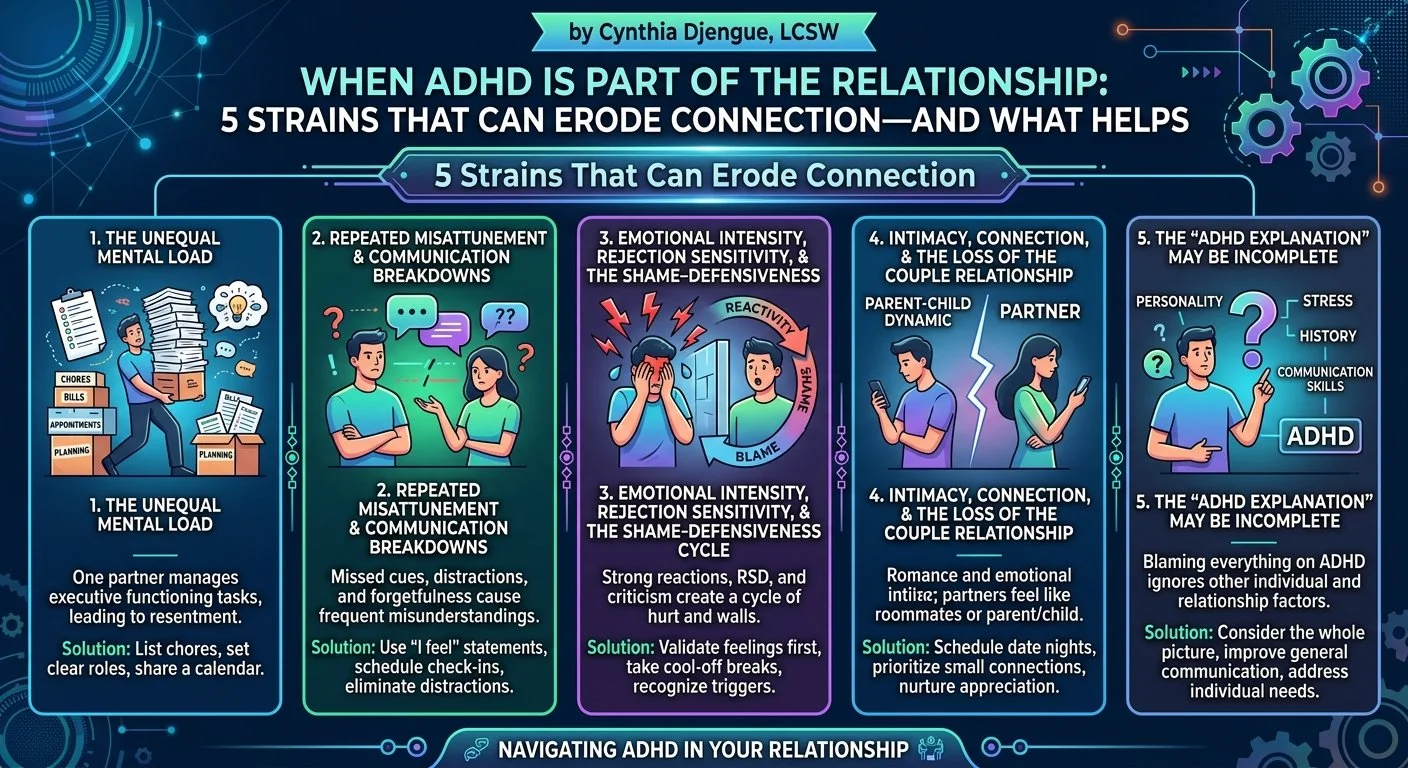
When ADHD Is Part of the Relationship: 5 Strains That Can Erode Connection, and What Helps. Cynthia Djengue, LCSW, ADHD Coach
3. Emotional intensity, rejection sensitivity, and the shame –defensiveness cycle
Not every adult with ADHD experiences significant emotional dysregulation, and emotional dysregulation is not itself required for an ADHD diagnosis. Still, many adults describe fast emotional escalation, low frustration tolerance, impulsive reactions, or intense sensitivity to perceived rejection or criticism.
In a relationship, ordinary feedback may land as:
“You think I am a failure.”
“Nothing I do is good enough.”
“You are trying to control me.”
“You do not love or respect me.”
The partner raising the concern may then feel they have to soften, delay, or suppress their needs to avoid a major reaction. Eventually, resentment builds on both sides.
This dynamic is especially likely when ADHD has been accompanied by years of criticism, academic or work struggles, family conflict, masking, or late diagnosis. Shame can make it difficult to take responsibility without collapsing into self-attack or defensiveness.
The goal is not for either partner to walk on eggshells. It is to separate impact from intent:
“I believe you did not mean to hurt me. And the impact is that I felt dismissed when you walked away while I was talking. I need us to come back to this conversation at 7:00.”
This approach holds compassion and accountability together. A partner’s nervous system may become activated quickly, but repair requires returning to the conversation, acknowledging impact, and making a concrete plan for handling it differently next time.
4. Intimacy, connection, and the loss of the couple relationship
ADHD can affect emotional and physical intimacy in several ways. A person may be deeply affectionate but forget to initiate connection, arrive late to shared time, be absorbed in work or screens, lose track of promises, or struggle to transition from the demands of parenting and daily life into emotional or sexual closeness.
The other partner may interpret this as rejection: “If I mattered, you would remember,” or “You have energy for everything except us.”
The issue is often not a lack of love. It may be a lack of protected attention, transition time, communication, rest, regulation, or shared systems. But over years, repeated missed bids for connection can create a painful loneliness inside the relationship.
Studies and reviews have found associations between ADHD symptoms and lower relationship quality, with partners of adults with ADHD reporting lower intimacy and marital satisfaction on average.
Hallowell and his wife, Sue Hallowell, emphasize making regular time for conversation, planning, shared enjoyment, and intimacy rather than expecting closeness to survive on leftovers after work, parenting, screens, and household labor.
For many midlife couples, rebuilding intimacy begins well before sex. It may look like:
Re-establishing a predictable weekly check-in
Protecting time without phones or television
Repairing unresolved resentment around labor and responsibility
Creating transition rituals after work or parenting
Talking openly about hormonal change, sleep, medication effects, stress, health, and desire
Replacing blame with direct requests for connection
5. The “ADHD explanation” may be incomplete
ADHD rarely exists in a vacuum. A relationship may become much more complex when ADHD overlaps with trauma, PTSD, complex trauma, autism, depression, anxiety, chronic illness, substance use, burnout, or major hormonal and life-stage changes.
ADHD and trauma
Trauma-related hyper-vigilance, avoidance, shutdown, anger, sleep disruption, distrust, or emotional flooding can overlap with and intensify ADHD-related difficulties. PTSD is independently associated with impaired relationship functioning, and depression, anger, and aggression are among the commonly studied factors that help explain that relationship strain.
For example, a partner who appears distracted may be experiencing ADHD-related attentional difficulty. Another may shut down because conflict triggers a trauma response. Both may need support, but the intervention is not identical. A calendar app cannot resolve a trauma-driven freeze response, and trauma processing alone may not solve chronic time blindness or disorganization.
ADHD and autism: AuDHD
People with co-occurring autism and ADHD, often called AuDHD in community settings, may experience a different relationship presentation than someone with ADHD alone. They may have overlapping executive-function challenges along with sensory sensitivities, a strong need for predictability, direct or literal communication preferences, social exhaustion, or shutdown during overload.
Research indicates that communication difficulties can be greater in people with co-occurring ADHD and autism than in those with either condition alone.
A partner’s withdrawal after a loud family gathering, for instance, may not mean indifference or rejection. It may be a nervous-system response to sensory and social overload. The relationship needs a clear agreement such as: “I am overloaded. I need 30 minutes alone. I will come back, and I am not abandoning this conversation.”
The central distinction
A diagnosis can create clarity. It should not become a permanent exemption from participation, repair, treatment, or change.
A healthy relationship asks both people to learn:
What is ADHD, trauma, autistic overload, depression, or anxiety?
What is a learned relational habit?
What is a reasonable accommodation?
What responsibility belongs to each partner?
What repair is needed after harm occurs?
ADHD, midlife, and gray divorce
This conversation matters especially in midlife and later life. “Gray divorce” generally refers to divorce among adults age 50 and older. The rate rose sharply in the United States from 3.9 divorces per 1,000 married women age 50 and older in 1990 to 11.0 in 2008. Since then, the overall gray-divorce rate has largely leveled off, measuring 10.3 per 1,000 married women age 50+ in 2023. Even so, gray divorce now accounts for nearly 4 in 10 divorces in the United States, compared with just 8% in 1990.
The more recent shift is especially striking among adults age 65 and older. In 2022, 15.2% of Americans age 65+ were divorced, compared with 5.2% in 1990, and approximately 1 in 10 people divorcing in the United States was age 65 or older.
ADHD does not cause divorce. But midlife can expose coping strategies and relationship arrangements that once kept a couple functioning. As children leave home, careers change, parents require care, health and sleep shift, menopause or andropause enter the picture, and people begin asking what they want from the next decades of their lives, longstanding inequities, unresolved hurt, untreated ADHD, trauma responses, and emotional disconnection may become harder to minimize.
Why women may be especially visible in midlife ADHD conversations
Women and girls have historically been under-recognized and under-diagnosed with ADHD, particularly when their symptoms are more inattentive, internalized, masked, or expressed through anxiety, over-functioning, people-pleasing, exhaustion, and chronic self-criticism rather than obvious hyperactivity.
Perimenopause and menopause can add sleep disruption, cognitive changes, emotional volatility, and worsening executive-function strain. CHADD notes that many women experience midlife as a period when previously unrecognized or untreated ADHD becomes more difficult to manage in the context of hormonal change.
A woman who has spent decades compensating - managing children, work, home, aging parents, and the emotional climate of the family - may reach a point where she cannot or will not continue carrying the same invisible load. That is not evidence that women “cause” divorce or that menopause ruins marriages. It may be the point at which a long-standing imbalance can no longer be ignored.
What about men?
Men with ADHD may be more likely to have been identified earlier when symptoms were outwardly hyperactive, impulsive, or disruptive, though many men also remain undiagnosed well into adulthood. In marriage, ADHD-related challenges may show up through impulsive spending, inconsistent follow-through, distraction, work instability, risk-taking, irritability, missed obligations, or emotional avoidance.
These are broad patterns, not rules. The research does not support treating “men’s ADHD” and “women’s ADHD” as fixed marital roles. In fact, reviews find relatively few consistent sex differences in the relationship challenges experienced by adults with ADHD, while noting that women with ADHD may face particular relationship difficulties and higher divorce risk in some studies.
The clinical question is not, “Which gender is harder to be married to?” It is, “What is the actual pattern in this couple, and what has each person been carrying, avoiding, tolerating, or trying unsuccessfully to solve?”
What helps a relationship affected by ADHD
The most effective work is usually not about proving who is right. It is about replacing a repeating cycle with practical support, accountability, emotional safety, and repair.
Helpful starting points include:
A thorough adult ADHD evaluation when symptoms are suspected or treatment is not working
Evidence-based ADHD treatment, which may include medication evaluation, psychotherapy, skills work, coaching, sleep support, and treatment for co-occurring conditions
ADHD-informed couples therapy that understands executive functioning, emotional regulation, attachment, conflict cycles, and shame
A written, visible division of labor rather than vague verbal agreements
Shared calendars, reminders, automated bills, task boards, routines, and defined ownership of recurring responsibilities
Scheduled relationship meetings that are separate from spontaneous arguments
Trauma-informed work when PTSD, complex trauma, dissociation, chronic shutdown, or hyper-arousal are part of the picture
Sensory and communication accommodations for AuDHD couples, including lower-verbal-load conversations, planned breaks, clear return times, and direct requests
Individual support for each partner, not only the person with ADHD
Gina Pera, Melissa Orlov, and Edward and Sue Hallowell have each helped bring attention to the ways untreated or poorly understood ADHD can shape couple dynamics. Their core message is compatible with the research: learn about ADHD, stop moralizing symptoms, address real impact, avoid parent-child dynamics, build external supports, and require active participation from both partners.
Living with ADHD in a relationship can be isolating. You may love your partner and still feel exhausted, lonely, angry, confused, or unsure how to ask for change without another blowup. The ADHD Partner Support Group offers a compassionate, structured space to understand ADHD-related relationship patterns, reduce shame, strengthen boundaries, and connect with others who truly understand. Learn more or join the interest list here: https://www.psychologytoday.com/us/groups/adhd-partner-support-portland-or/293550