

One of the hardest transitions for parents of ADHD young adults isn't sending them to college.
It's learning how to stop being their executive functioning system.
For years, you've helped remember deadlines, navigate paperwork, solve problems, organize schedules, and catch things before they became crises. In many ways, those supports were necessary. ADHD brains often benefit from scaffolding, and parents frequently become that structure.
Then comes college.
Suddenly, the expectation is independence.
Yet many ADHD students still struggle with planning, time management, emotional regulation, task initiation, and problem-solving. When something goes wrong, missing a deadline, forgetting financial aid paperwork, bombing an exam, losing housing documents, or mismanaging a schedule, panic can quickly take over.
And when your child panics, your nervous system may panic, too.
The challenge becomes this:
How do you remain supportive without becoming responsible
The goal is not abandonment.
The goal is becoming a consultant rather than a rescuer.
The Hummingbird Principle:Hover, Don't Carry
A hummingbird can pause beside a flower without carrying the flower for miles. Similarly, your role is to provide guidance, encouragement, and perspective without taking ownership of tasks that belong to your young adult.
When parents repeatedly rescue, two things often happen:
The student misses opportunities to develop confidence and problem-solving skills.
The parent becomes exhausted, resentful, or overwhelmed.
Neither outcome serves the relationship.
Instead, consider these four steps when your college student arrives in a state of panic.
Step 1: Calm the Storm Before Solving the Problem
Many ADHD students enter crisis mode before they've had a chance to think clearly.
You may hear:
"I failed everything."
"Nobody else struggles with this."
"My roommate's mom already fixed this for them."
"If you cared, you'd help me right now."
When emotions are high, facts are often inaccessible.
Instead of responding to the details immediately, respond to the emotional reality underneath.
Hummingbird Response
"You sound incredibly overwhelmed right now. I can see how stressful this feels. Let's slow down and look at what's actually happening."
Notice what this response does:
Validates emotions
Avoids arguing
Refuses comparisons
Creates emotional safety
Regulation comes before problem-solving.
Always.
Step 2: Refuse the Urgency Trap
ADHD crises often feel like emergencies.
Sometimes they are.
Most of the time they are urgent tasks that feel emotionally catastrophic.
Parents frequently get pulled into emergency mode themselves:
Dropping work
Canceling plans
Making calls
Writing emails
Taking over logistics
While this may solve today's issue, it can unintentionally teach your student that panic is the fastest path to assistance.
Instead, introduce a pause.
Hummingbird Response
"I can hear that this feels urgent. I'm not available to drop everything and solve it right now. I am available at 6:00 tonight to sit down with you and create a plan."
This creates two important lessons:
Strong emotions are survivable.
Planning is more effective than panic.
ADHD brains often need help slowing down enough to think. You can model that regulation.
Step 3: Stay Beside Them, Not In Front of Them
This is where many loving parents accidentally cross the line into over-functioning.
You may find yourself:
Calling professors
Filling out forms
Scheduling appointments
Writing emails
Contacting disability services
Managing calendars
The intention is love. The outcome can be dependence. Think of yourself as a guide sitting beside your student, not a manager taking over their responsibilities.
Hummingbird Response
"I'm happy to help you break this into smaller steps. I can review the email before you send it. I can help you figure out your options. But your hands have to do the work."
You are providing scaffolding. Not substitution. The difference matters.
Step 4: Don't Carry Their Consequences
Perhaps the most painful part of parenting an ADHD young adult is watching them experience setbacks that may have been preventable.
Missed deadlines. Late fees. Lost opportunities. Academic struggles. Natural consequences can be difficult for parents to tolerate. Especially when we know exactly how to fix the problem.
Yet resilience develops through experience, not rescue.
Hummingbird Response
"I know this is really disappointing. I believe you're capable of figuring out the next step. I'll support you while you work through it."
Notice the balance:
Empathy without taking over.
Confidence without minimizing.
Support without rescuing.
This is where growth happens.
The Consultant vs. The Rescuer
When you aren't sure whether you're helping or over-helping, ask yourself if you are behaving as:
The Rescuer
Fixes the problem
Takes ownership
Absorbs the stress
Sacrifices personal boundaries
Believes, "It's easier if I just do it."
The Consultant
Helps clarify options
Offers perspective
Provides encouragement
Maintains boundaries
Believes, "I can support without taking over."
The consultant doesn't do less caring.
The consultant does more trusting.
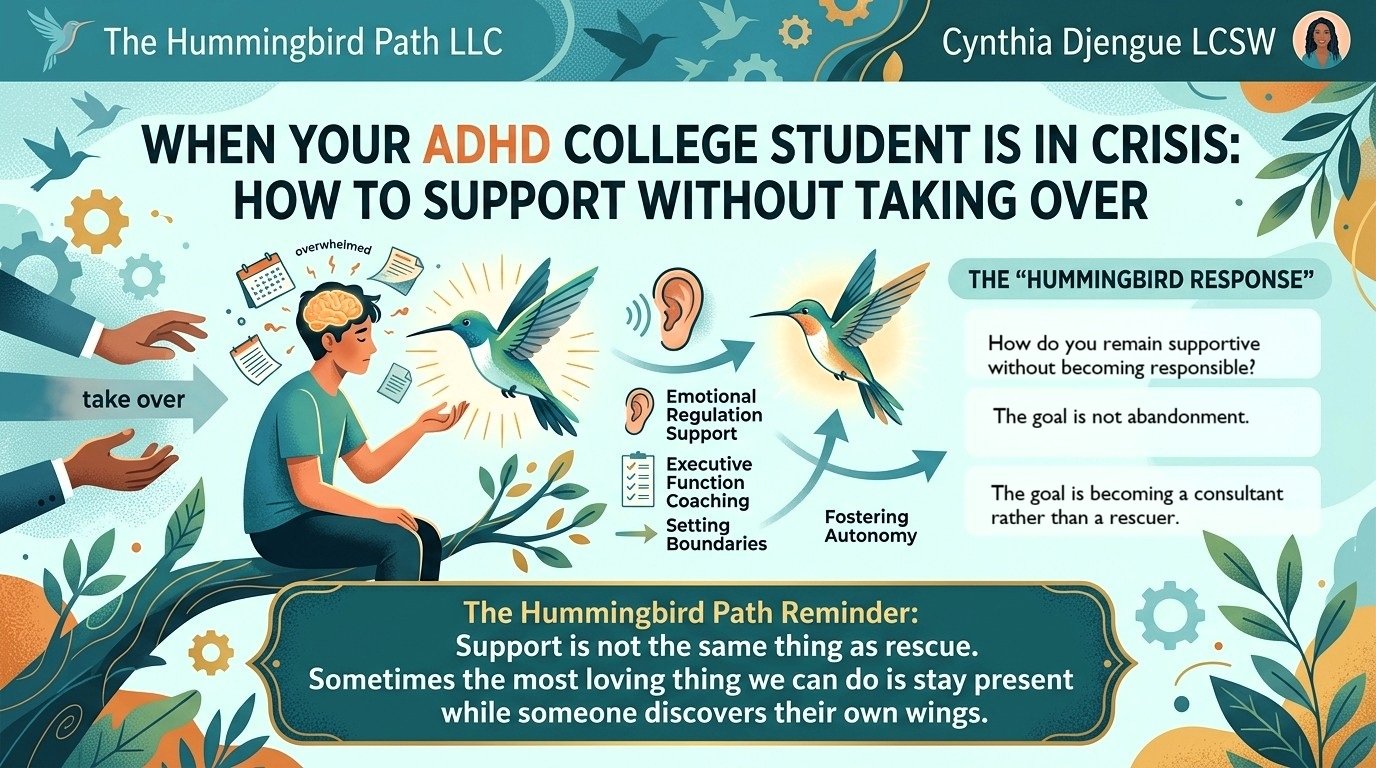
When your ADHD college student is in crisis: how to support without taking over. Cynthia Djengue, LCSW, LISW, ADHD Certified Psychotherapist
A Final Thought for ADHD Parents
Many parents fear that stepping back means being unsupportive.
In reality, healthy support often looks less dramatic than rescue.
It sounds like:
"What have you already tried?"
"What's your next step?"
"How can I help you think this through?"
"I believe you can handle this."
Your child does not need a parent who prevents every struggle.
They need a parent who communicates, again and again:
"I trust you to grow through this, and I'll stay beside you while you do."
At The Hummingbird Path, we often remind parents and families that independence isn't built in one giant leap. It's built one supported step at a time, with just enough structure to encourage growth and just enough space to let confidence emerge.
That's how young adults learn to carry themselves.
And that's how parents finally get to put down the weight they were never meant to carry forever.
Clinical Reflection Questions for Parents:
Am I helping my child think, or am I doing the thinking for them?
Am I responding to an actual emergency or an emotional emergency?
What would support look like if I trusted my child's ability to learn from this?
If I solved this problem today, what skill might they miss practicing tomorrow?
How can I remain connected without becoming responsible?
The Hummingbird Path Reminder: Support is not the same thing as rescue. Sometimes the most loving thing we can do is stay present while someone discovers their own wings.