

A question from the therapy room.
Recently, while exploring parts work with a client, we were discussing how trauma can shape the ways we think, feel, react, and relate to others. We had been identifying moments when a childhood part was speaking rather than the client's integrated adult self.
At one point, they paused and asked:
"What's the litmus test? How do I know when I'm acting out of trauma?"
It's a thoughtful question and one many people ask once they begin recognizing their own patterns.
The answer is both simple and nuanced.
First, What Do I Mean by "Acting Out of Trauma"?
When I use this phrase, I'm not suggesting someone is being dramatic, irrational, or intentionally difficult.
I'm referring to moments when a protective part takes over.
These parts often formed in childhood or during other periods of overwhelm. They developed for a very good reason. They helped us survive environments where we felt unsafe, unseen, rejected, criticized, abandoned, or responsible for things that were never ours to carry.
The problem is not that these parts exist.
The problem is that they often continue using yesterday's survival strategies in today's relationships.
A protective response that made sense when you were eight may create distance, conflict, or suffering when you're forty.
The Litmus Test
The simplest litmus test I know is this:
Is your current reaction proportional to the current situation, or is it carrying emotional weight from the past?
When an adult self is responding, there is generally some flexibility.
You may feel hurt, angry, disappointed, or frustrated, but there is still room for reflection, curiosity, and choice.
When a trauma-held part takes over, the response often feels urgent, absolute, and much larger than the circumstances alone would explain.
You may find yourself:
Feeling intensely threatened by a relatively minor interaction
Becoming disproportionately angry or defensive
Shutting down completely
Feeling abandoned after a small disappointment
Experiencing overwhelming shame after a mistake
Rehearsing arguments long after they end
Feeling compelled to prove, defend, or protect yourself
The nervous system is responding as though an old wound has been reopened.
Because, in many ways, it has.
Trauma Parts Often Speak in Absolutes
One clue that a younger part may be present is the language inside your mind.
You might notice thoughts such as:
"They never listen to me."
"Nobody cares about me."
"I'm always the problem."
"I can't trust anyone."
"I'm going to be abandoned."
"I'm not enough."
These thoughts often carry the emotional tone of a younger age.
The integrated adult self, by contrast, tends to hold more complexity.
It sounds more like:
"I'm feeling hurt right now."
"This situation reminds me of older experiences."
"I don't feel understood."
"I need to slow down before responding."
"Something about this interaction feels activating."
The adult self is capable of perspective.
The trauma part is often focused on survival.
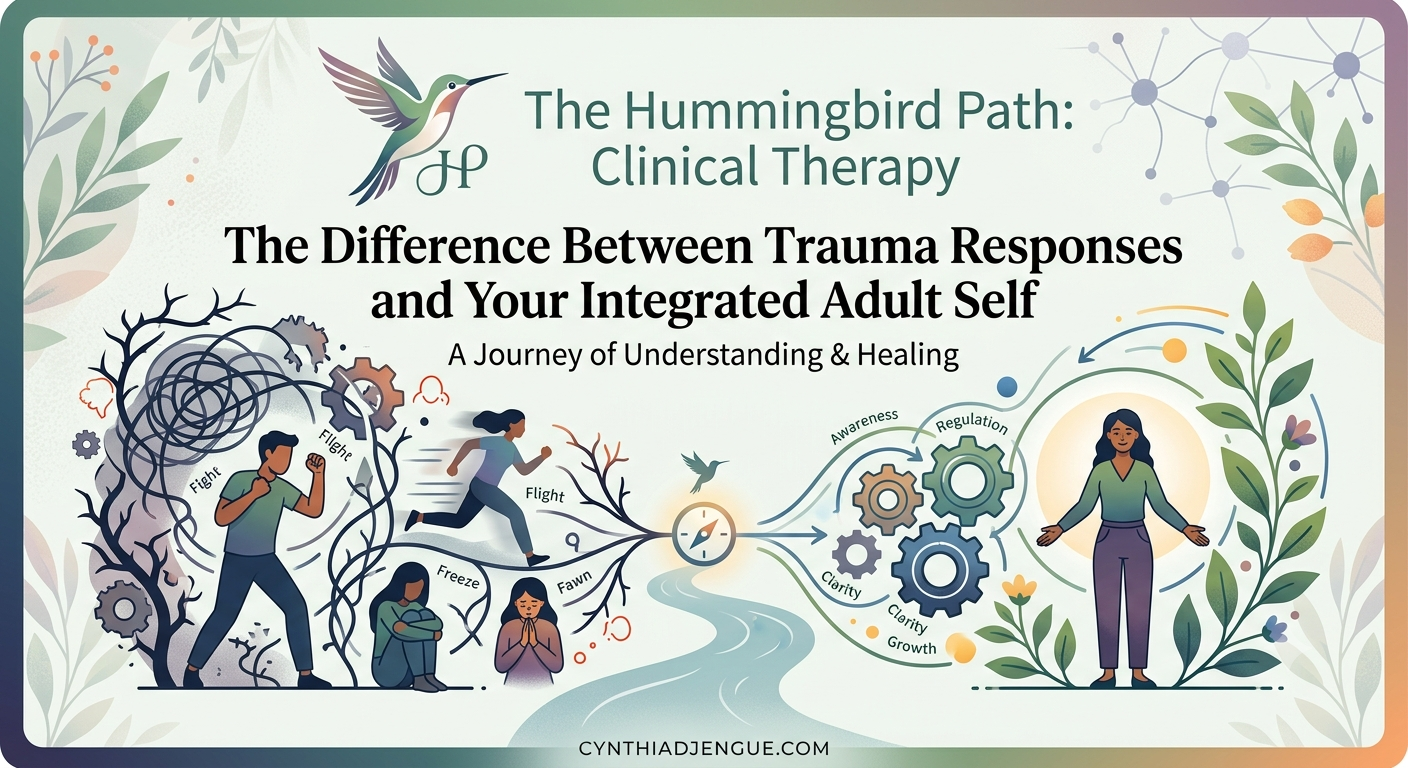
How to Tell When You're Acting Out of Trauma: A Therapist's Litmus Test, Cynthia Djengue, LCSW
Notice What Happens to Choice
Another useful indicator is whether you still feel you have options.
When we are grounded in our adult selves, we can typically pause before responding. We can consider different viewpoints. We can tolerate discomfort without immediately acting on it.
When a trauma response is activated, choice often narrows.
Everything feels immediate.
You may feel compelled to:
Send the text
End the relationship
Defend yourself
Withdraw completely
Demand reassurance
Avoid the conversation
The nervous system shifts from flexibility to protection.
This doesn't mean you're doing something wrong. It simply means a protective part believes your safety is at stake.
Trauma Responses Are Often About Protection, Not Pathology
One of the most important shifts in trauma therapy is moving away from asking:
"What's wrong with me?"
And toward asking:
"What is this part trying to protect?"
The angry part may be protecting a vulnerable part.
The perfectionistic part may be protecting against shame.
The people-pleasing part may be trying to maintain connection.
The highly independent part may be protecting against disappointment.
Most trauma responses make sense when we understand the story behind them.
The Goal Isn't to Get Rid of Parts
Many people assume healing means eliminating these responses altogether.
It doesn't.
The goal is not to exile the protective parts that helped you survive.
The goal is to recognize when they are driving the car.
As we develop awareness, we become better able to pause and say:
"I know this feeling."
"A younger part of me is activated right now."
"This reaction makes sense given my history."
"And I want to respond from my present-day self."
That moment of recognition creates space.
And in that space, new choices become possible.
Learning to Respond From Your Integrated Self
An integrated adult self doesn't never get triggered.
An integrated adult self notices the trigger.
It can hold both the past and the present at the same time.
It recognizes old pain without allowing that pain to make every decision.
This is the work of trauma healing.
Not becoming someone new.
But becoming more fully connected to who you already are beneath the protective strategies.
Ready to Explore Your Patterns More Deeply?
If you find yourself repeating the same relationship conflicts, struggling with emotional reactivity, people-pleasing, perfectionism, anxiety, or attachment wounds, you're not broken.
Many of these patterns began as intelligent adaptations to difficult experiences.
Therapy can help you understand the parts of yourself that developed for protection, strengthen your connection to your integrated adult self, and create new ways of navigating relationships, emotions, and life transitions.
If you're ready to explore trauma, attachment, nervous system patterns, or parts-informed therapy, I'd be honored to support you.
Schedule a therapy consultation today to learn more about individual therapy services in Arizona, Iowa, and Oregon.
Healing begins not when we stop having protective parts, but when we learn to listen to them with curiosity rather than judgment.